
India’s Education Industry: A Resilient and Expanding Opportunity
The Indian education industry is one of the largest and fastest-growing in the world, characterized by its resilience, demographic advantage, and a powerful policy push towards skill development and innovation.
Market Overview
Valued at $165 billion in 2024, India’s education market is projected to grow at a CAGR of 11% to reach $434 billion by 2033. Growth is being driven by both formal segments K-12 and higher education, and rapidly expanding non-formal segments, particularly EdTech.
With 250 million school-going students, 1.5 million schools, and 10 million teachers, India’s education sector represents a vast and recession-proof market sustained by non-discretionary household spending.
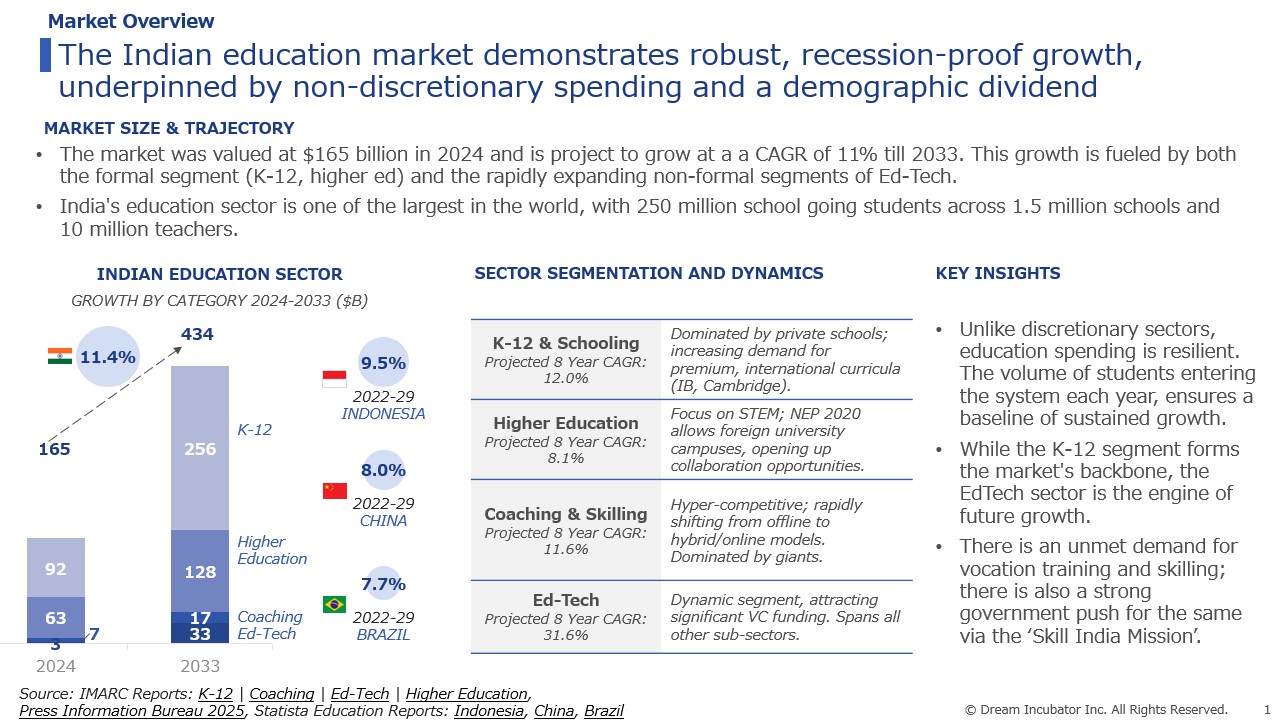
Market Segmentation and Dynamics
The K-12 segment remains the backbone of India’s education system, while EdTech serves as the engine of future growth. Additionally, there is a large unmet demand for vocational training and skilling, supported by strong government initiatives such as the Skill India Mission.
Higher Education as an Innovation Catalyst
At the apex of the education pyramid, India’s premier institutions, including the IITs and IISc, are transforming from teaching centers into innovation hubs.
IISc Bengaluru’s ARTPARK, established in 2022 with $30 million in joint federal and local funding, drives R&D across healthcare, education, mobility, and cybersecurity.
National Robotics & AI Technology Hub (RAIT), set up in 2024 by MeitY in collaboration with IITs and NITs, focuses on robotics, automation, and space innovation.
IIT Bombay’s Quantum Computing & AI Hub (2024) supports startups working on quantum-AI applications across multiple sectors.
India now ranks 39th globally in the Global Innovation Index 2024, with strong performance in knowledge and technology (rank 22), though continued investment in infrastructure is needed to fully realize innovation potential.
Tailwinds and Headwinds
Key Drivers (Tailwinds):
- Favorable demographics (68% aged 15–64; median age 29) and an expanding middle class.
- Policy reform under NEP 2020, focusing on skills, technology, and affordability.
- Rising investor confidence and foreign collaboration in higher education.
Key Challenges (Headwinds):
- High customer acquisition costs in EdTech (over ₹15,000 per student).
- Limited digital reach, with rural internet penetration at ~37%.
- Persistent focus on rote learning over skill-based education, contributing to 24% unemployment among educated youth.
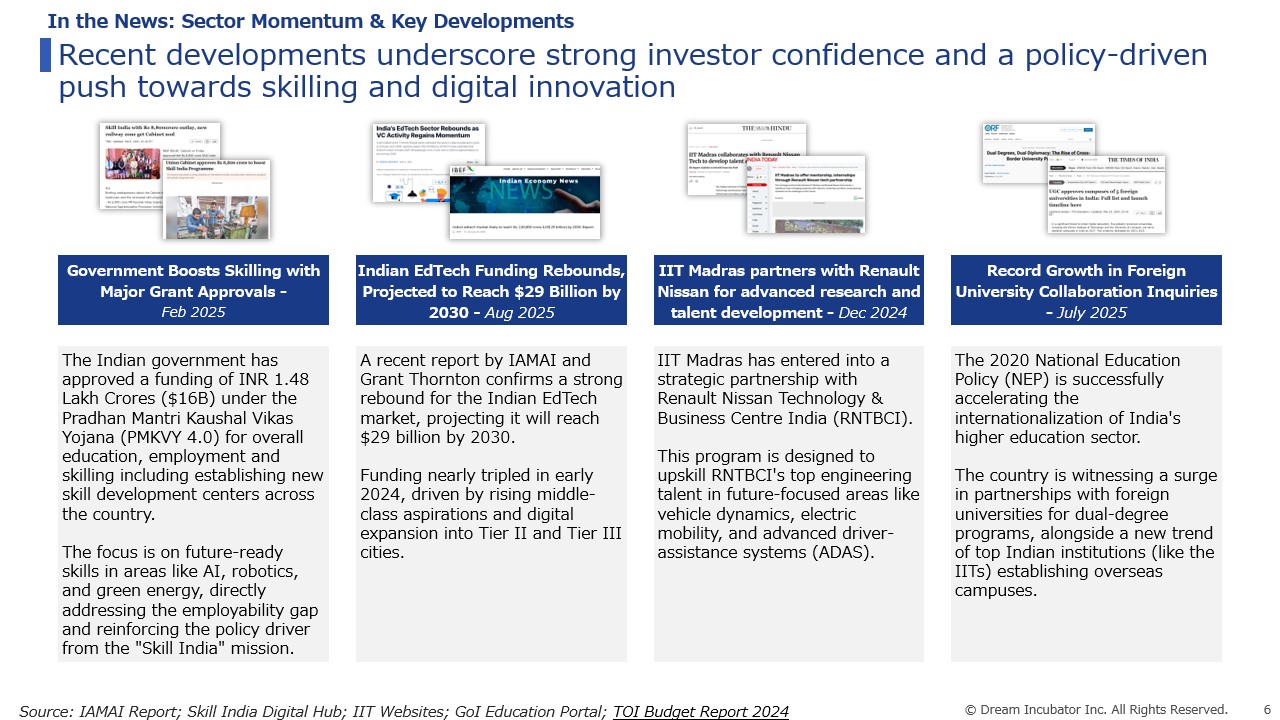
In the News: Sector Momentum
- Feb 2025: Government approved INR 1.48 lakh crores ($16B) under PMKVY 4.0 to boost skilling in AI, robotics, and green energy.
- Aug 2025: EdTech funding rebounded sharply; projected to reach $29B by 2030.
- Dec 2024: IIT Madras–Renault Nissan partnership launched for advanced research in electric mobility and ADAS.
- July 2025: Record rise in foreign university collaborations and dual-degree partnerships.
Opportunities for Japanese Firms
1. The Industrial Skilling Mandate: Building the Future Workforce
Japan’s proven strengths in manufacturing, automation, and quality management align directly with India’s “Skill India” agenda.
Engagement routes:
- Establish Indo-Japanese Centers of Excellence for vocational training in automotive/EV, electronics, and robotics.
- Develop Japan-certified skill modules creating a direct talent pipeline for Japanese companies in India.
Entry models: Joint ventures with Indian industrial or educational institutions.
2. The Innovation Bridge: Capitalizing on the Lab-to-Market Gap
India’s premier institutes are producing deep-tech IP and startups that can benefit from Japanese mentorship and investment.
Engagement routes:
- Invest or acquire high-potential startups in AI, robotics, clean tech, and healthcare emerging from IIT/IISc incubators.
- Form R&D partnerships to co-develop technology using India’s cost-effective research talent.
Entry models: Corporate venture capital (CVC) investments and targeted M&A.
Key Strategic Questions for Japanese Players
- Can partnerships with top Indian institutes provide access to the innovation pipeline?
- Can Japanese pedagogical models be scaled for India’s K-12 market?
- Is there an opportunity to act as a strategic acquirer for deep-tech startups?
- Can education-sector partnerships build future-ready workforces for both Indian and Japanese operations?
Partner with DIAI India Private Limited
DIAI India Private Limited, the India arm of Dream Incubator Inc., supports Japanese companies in identifying, entering, and scaling in India’s education sector. From market research to partnership strategy and business case development, DIAI helps bridge Japan’s technical strengths with India’s education and innovation ecosystem.